How to run mock interviews at scale (School playbook + templates)
The easiest way to run mock interviews at scale is a station model: students rotate through short interviews on a timer, every interviewer uses the same rubric, and each student leaves with one strength + one next step. This playbook gives you a simple schedule template, question bank, and printable forms so you can run mock interviews across a whole grade level (or an entire district) without chaos.
School counselors
CTE teachers
Playbook
Templates
Career readiness teams
What “scale” means (so you plan the right format)
Small scale
1 class / between 25–35 students
- 1 period or one afternoon
- Pairs or 3–4 interview stations
- Teacher + 1–2 adults
Large scale
Whole grade / 100–300+ students
- Multiple sessions (AM/PM)
- 8–20 stations with rotations
- Consistent rubric + quick scoring
The station model (the simplest system that works)
Think of mock interviews like a well-run assessment rotation. You standardise the experience so every student gets a fair chance and every adult can give consistent feedback.
- Timing: 8–10 minutes interview + 2 minutes feedback (per student)
- Stations: each station has an interviewer + the same question set
- Rubric: 3 categories only (Structure, Specificity, Delivery)
- Output: 1 strength + 1 next step + optional goal
Step-by-step: how to run mock interviews at scale
Step 1: Pick your “unit” and schedule
- Unit: one grade level, one pathway, one cohort, or one school.
- Schedule: block out interview windows (e.g., 2–4 hours) and decide on rotations.
- Goal: every student gets one interview + one feedback moment (minimum viable).
Step 2: Recruit interviewers (and keep it easy for them)
The secret to volunteer/interviewer recruitment is removing friction. Give them a one-page briefing, a question set, and a simple rubric.
- Staff: counselors, teachers, administrators, support staff
- Community: employers, alumni, parents/guardians (as appropriate)
- Partners: workforce boards, chambers, colleges, career services
Step 3: Standardise questions (so scoring stays fair)
Use 6–10 questions total and tell interviewers to choose 2 questions per student. This keeps timing predictable.
Step 4: Use a “3-category rubric” for speed
- Structure (STAR): clear example, includes result
- Specificity: real details (what the student did)
- Delivery: pace, clarity, confidence
Tip: If you add too many categories, feedback slows down and stations fall behind.
Step 5: Run rotations with a visible timer
- Start every interview on the same cue (bell/timer announcement).
- At minute 8–10: stop questions and switch to feedback.
- At minute 12: rotation moves.
Step 6: Capture results (lightweight is fine)
You don’t need a complex system. Start with a simple tracker: student name, station, rubric rating, and next step.
Recommended question set (high school)
- Tell me about yourself.
- Why do you want this role/program/pathway?
- Tell me about a time you solved a problem. (STAR)
- Tell me about a time you worked on a team. (STAR)
- What’s a strength you’re proud of?
- What’s one thing you’re working to improve?
- How do you handle feedback?
- What questions do you have for us?
What to do if students are very nervous
- Let them practise one answer with a peer first (60 seconds).
- Allow a “restart once” rule (reduces panic).
- Give them sentence starters (STAR prompts).
- Remind them: confidence is repetition, not talent.
Success metrics (simple, counselor-friendly)
- Participation: % of students completing at least one interview
- Quality: rubric improvement from round 1 → round 2
- Confidence: quick 1–5 self-rating before/after
- Follow-through: % of students who set a next-step goal
Related resources

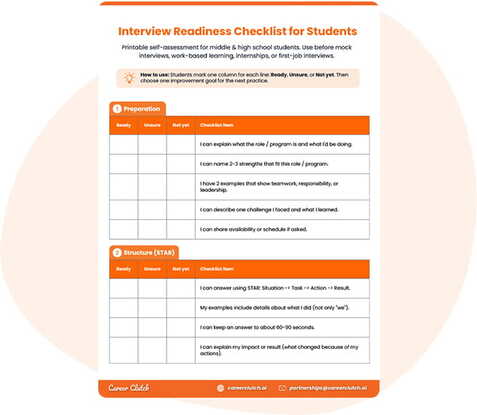 Download PDF