Career readiness activities for high school (10 counselor ideas)
When schools talk about a “lack of career readiness,” it usually means students are missing one (or more) of these: self-awareness (strengths/skills), career knowledge (pathways), and work-ready behaviors (communication, professionalism). The fastest fix is a consistent set of short activities that build these skills every week—plus mock interview practice with clear feedback.
School counselors
CTE teachers
Activities
High school
Career readiness teams
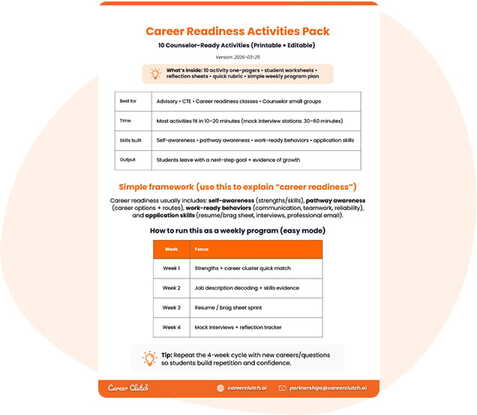
What “career readiness” really includes (simple framework)
- Self-awareness: strengths, interests, skills, values
- Pathway awareness: career clusters, training routes, postsecondary options
- Work-ready behaviors: communication, teamwork, reliability, professionalism
- Application skills: resume/brag sheet, interview skills, professional email
10 counselor-ready career readiness activities
1) Career cluster quick match (10–15 min)
Students pick 3 interests + 3 strengths, then match to 2 career clusters and explain why.
2) Skills inventory + evidence (15 min)
Students list 5 employability skills and write one piece of evidence for each (“I showed this when…”).
3) Postsecondary pathways comparison (15–20 min)
Compare 3 routes for a chosen career: apprenticeship, community college, 4-year, military, certifications.
4) Resume / brag sheet sprint (20–30 min)
Students create a brag sheet: achievements, responsibilities, clubs, service, and 3 STAR stories.
5) Mock interview stations (30–60 min)
Timed rotations: 10-minute interview + 2 minutes feedback using a 3-category rubric.
6) Professional email + follow-up (10–15 min)
Students practise writing a short, professional email and a thank-you follow-up after an interview.
7) Job description decoding (15 min)
Underline responsibilities, circle required skills, and translate each into “what I can show in an interview.”
8) Workplace scenarios role play (15–25 min)
Role play simple scenarios: late to shift, conflict with teammate, receiving feedback, asking for help.
9) Goal setting + action plan (10–15 min)
Students choose one skill to improve and set a 2-week plan with one practice action per week.
10) Reflection + growth tracker (5–10 min)
Students track what they practised, what improved, and their next step.
How to run this as a simple weekly program
- Week 1: strengths + career cluster quick match
- Week 2: job description decoding + skills evidence
- Week 3: resume/brag sheet sprint
- Week 4: mock interviews + reflection tracker
Repeat the cycle with new careers/questions so students build repetition and confidence.
Simple success metrics (so you can show impact)
- Participation: % of students completing at least one activity per month
- Readiness: pre/post self-rating on STAR confidence and pathway awareness
- Quality: rubric improvements across interview rounds
- Follow-through: % of students setting a next-step goal
Related resources

 Download PDF